Skip to content
Stackwatch, go to homepage

Early warning record

How early we warn, and how often we miss

Early warnings are unconfirmed hints from oss-security, CERTs, security blogs and social media that Stackwatch shows before an advisory is in the databases. This page shows what became of them: how much earlier they came, measured against two points in time, how many stayed without an advisory and what we missed.

As of 17 Nov 2026. Period: early warnings recorded since 19 Aug 2026 (90 days). Sample: 472 early warnings in the feed, 36 of them confirmed by an advisory.

Key figures

Each number with what it is made of.

The sample is small. Where fewer than 20 cases exist, we show no rate and no average, only the numbers themselves and the single cases.

Before the first publication

4 of 36

11%

Confirmed early warnings that were in the feed before the vulnerability was public: before the CVE record or, without a CVE, before the earliest entry of a source. If the CVE was already published, the case does not count here.

Longest lead time: 7 days

Before the entry in the GitHub Advisory Database

24 of 26

92%

Confirmed early warnings with an entry in the GitHub Advisory Database that were in the feed before that entry. From the entry on, tools built on this database can warn. It often follows days after the CVE.

Median lead time: 24.2 h

Longest lead time: 17 days

Coverage

2 of 53

4%

Advisories in the period that are listed in the CISA KEV catalog or rated critical, and that had an early warning before the first publication.

Coverage since 26 Oct 2026: advisories are counted from the first recorded early warning.

KEV: 1 of 14. Critical: 1 of 43.

Stayed without an advisory

0 of 0

Too few cases for a rate

Early warnings that still had no advisory 30 days after they were recorded. This is our false alarm rate.

Still open, deadline running: 436

Without an advisory, with mail

0 of 0

Too few cases for a rate

The same calculation only for early warnings that were allowed to trigger a mail: posts on oss-security and from official bodies, or two authors on two platforms.

Still open, deadline running: 70

Not counted: 32 cases where a post only showed up when we already had the advisory. They never appeared in the feed as an early warning.

Single cases with a lead

The confirmed early warnings in the period that were in the feed before the first publication, longest lead first. The numbers above count all confirmed early warnings, including those without a lead. The IDs lead to the CVE record and the advisory, so every case can be verified.

  • CVE-2026-119790, GHSA-mfr8-8qww-v76hCommunity postCleared for mail

    Next.js

    7 days before the first publication

    7 days before the entry in the GitHub Advisory Database

    Source of the first post
    Mastodon (Community post)
    First post
    9 Nov 2026, 19:00 UTC
    In the Stackwatch feed
    9 Nov 2026, 19:10 UTC
    CVE record published
    16 Nov 2026, 18:13 UTC
    Entry in the GitHub Advisory Database
    16 Nov 2026, 18:51 UTC
  • CVE-2026-97054, GO-2026-6859Official sourceCleared for mail

    Go

    4.6 days before the first publication

    Source of the first post
    BSI CERT-Bund (Official source)
    First post
    6 Nov 2026, 12:44 UTC
    In the Stackwatch feed
    6 Nov 2026, 12:50 UTC
    CVE record published
    11 Nov 2026, 03:13 UTC
    First entry of a source
    11 Nov 2026, 02:51 UTC
  • CVE-2026-119977Official sourceCleared for mail

    WordPress

    2.4 days before the first publication

    Source of the first post
    WordPress.org News (Official source)
    First post
    28 Oct 2026, 17:13 UTC
    In the Stackwatch feed
    28 Oct 2026, 20:01 UTC
    CVE record published
    31 Oct 2026, 05:33 UTC
  • CVE-2026-97054, GO-2026-6859Security sourceCleared for mail

    Go

    6.3 h before the first publication

    Source of the first post
    oss-security (Security source)
    First post
    10 Nov 2026, 20:17 UTC
    In the Stackwatch feed
    10 Nov 2026, 20:30 UTC
    CVE record published
    11 Nov 2026, 03:13 UTC
    First entry of a source
    11 Nov 2026, 02:51 UTC

How we measure

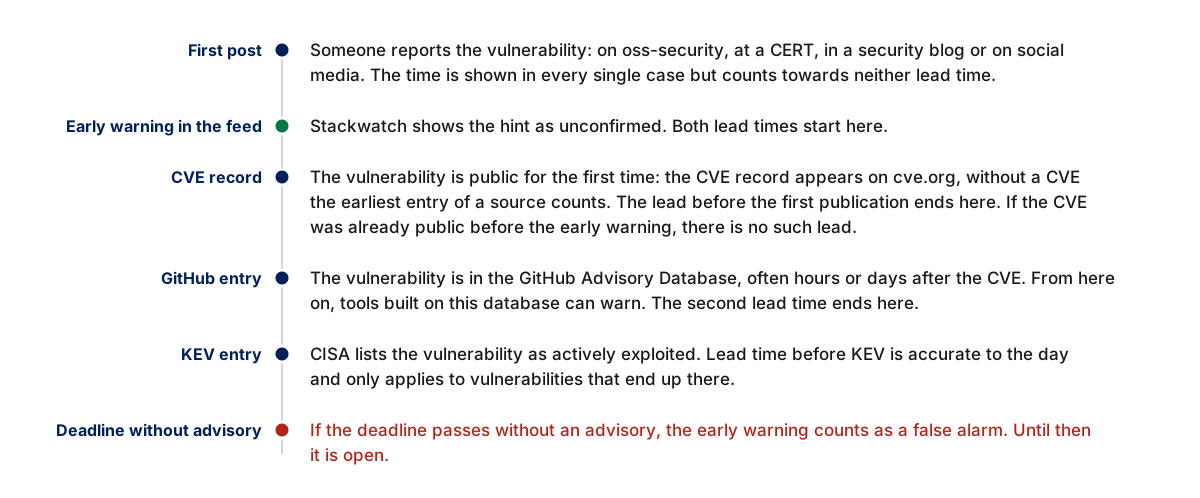
Timeline of an early warning and the two lead times the record measures on it. First post: Someone reports the vulnerability: on oss-security, at a CERT, in a security blog or on social media. The time is shown in every single case but counts towards neither lead time. Early warning in the feed: Stackwatch shows the hint as unconfirmed. Both lead times start here. CVE record: The vulnerability is public for the first time: the CVE record appears on cve.org, without a CVE the earliest entry of a source counts. The lead before the first publication ends here. If the CVE was already public before the early warning, there is no such lead. GitHub entry: The vulnerability is in the GitHub Advisory Database, often hours or days after the CVE. From here on, tools built on this database can warn. The second lead time ends here. KEV entry: CISA lists the vulnerability as actively exploited. Lead time before KEV is accurate to the day and only applies to vulnerabilities that end up there. Deadline without advisory: If the deadline passes without an advisory, the early warning counts as a false alarm. Until then it is open.
Two lead times from the appearance in the feed: to the first publication (CVE record) and to the entry in the GitHub Advisory Database.
Early warning
A hint at a vulnerability from oss-security, a CERT, security blogs, Hacker News, Bluesky or Mastodon that Stackwatch shows in the feed as unconfirmed. We count the early warnings recorded in the period.
Confirmed
An official advisory exists for the early warning: with the same CVE ID, or for the same product with an overlapping version range.
Lead before the first publication
The time from the early warning appearing in the Stackwatch feed to the moment the vulnerability was first public. That is the publication of the CVE record according to cve.org or, if earlier or without a CVE, the earliest entry of a source of the advisory. We count from our feed, not from the first post. If the CVE was already public when the warning appeared, that is not lead time.
Lead before the entry in the GitHub Advisory Database
The same calculation up to the entry of the vulnerability in the GitHub Advisory Database. From then on, tools built on this database can warn. The entry often follows the CVE only hours or days later, which is why we report both lead times separately.
Kind of source
Every single case names the source of the first post and its kind. Official sources are public bodies such as BSI CERT-Bund, CERT-EU and NCSC-NL and the vendor itself, for example WordPress.org. Security sources are the oss-security list, security companies and trade media. Everything else is a post from the community.
False alarm
An early warning that still has no advisory 30 days after it was recorded. The rate is its share of all early warnings whose 30 days are over. Younger ones count as open, not as false alarms. If the advisory arrives later after all, the early warning counts as confirmed from then on.
Coverage
Of the advisories in the period that are in the CISA KEV catalog or critical, the share that had an early warning in the feed before the first publication. Counting starts no earlier than the first recorded early warning: an advisory from before that could not have had one.
Sample
We only show rates and averages from 20 cases in the respective denominator. Below that, only the numbers and the single cases.
Limits of the measurement

  • The beta has been running since late October 2026. The sample is small, single cases shift every number noticeably.
  • No advisory does not necessarily mean wrong. A real vulnerability that never gets an advisory still counts as a false alarm here.
  • The first publication is the earliest moment we can prove: the CVE record according to cve.org and the entries of the sources Stackwatch reads. If the vulnerability was public elsewhere before, for example in a changelog, we do not see that.
  • The entry in the GitHub Advisory Database is the moment from which tools built on it can warn, not the moment a specific tool such as Dependabot actually reports. The comparison remains an approximation.
  • An official source such as BSI CERT-Bund or WordPress.org is itself already a publication. Lead time then measures how long before the CVE record and the databases this notice was in the feed.
  • The KEV catalog only states the date. A lead time before KEV is accurate to the day, not to the hour.
  • Coverage only counts advisories Stackwatch knows, and only early warnings from the sources we read. What nobody mentions there, we do not see earlier.
  • An early warning in the feed is not a verification. It never triggers an alert, only the advisory does.